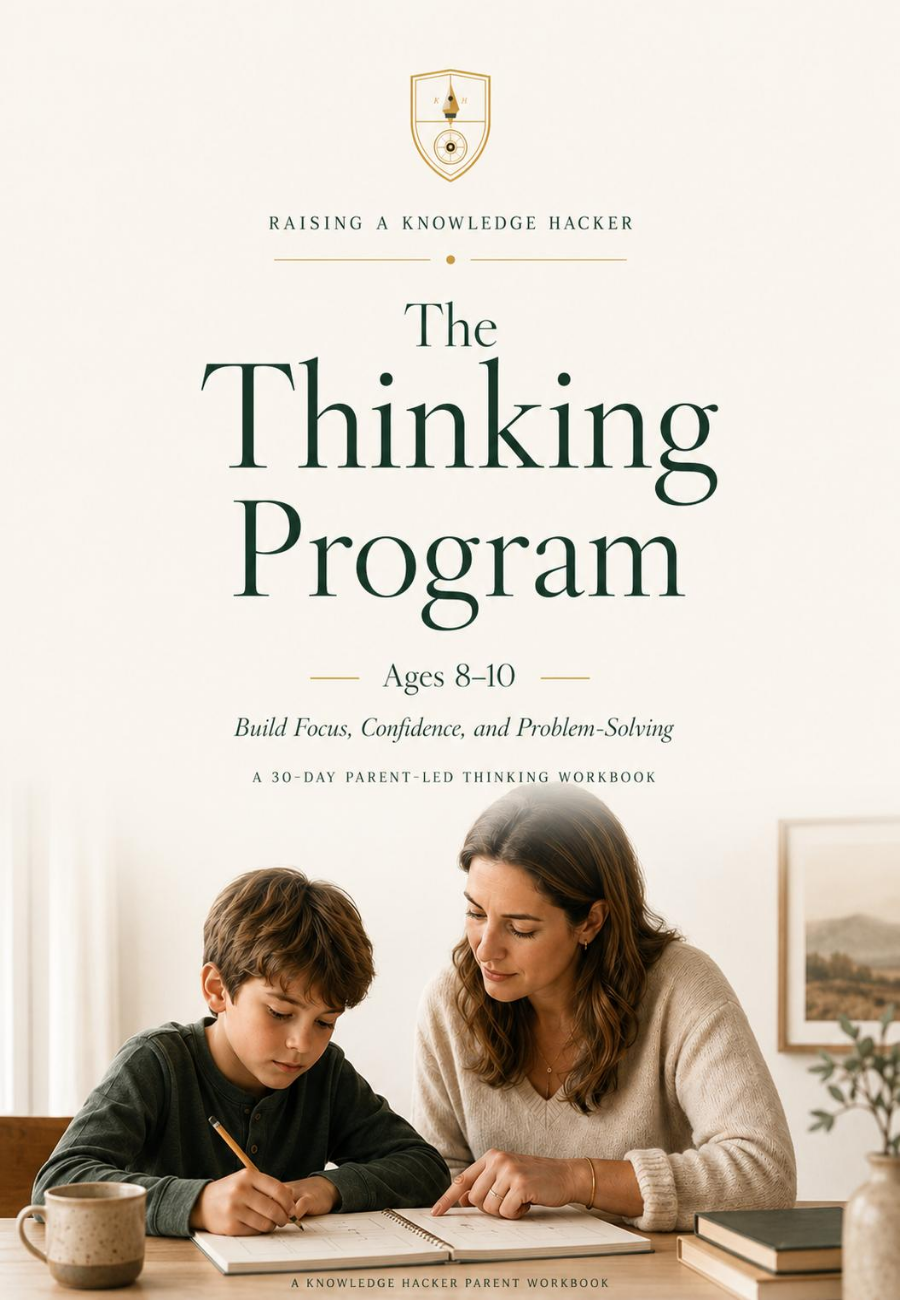
The Thinking Program (8-10 years old)

Ages 8–10  ·  30-Day Programme

The Thinking Program (8-10 years old)

Build focus, reasoning, flexibility, and independent thinking in an AI-shaped world.


Between ages 8 and 10, children are expected to remember more, follow longer instructions, explain their ideas, and work with growing independence.

But these skills don't appear automatically — they develop through repeated practice, calm guidance, and opportunities to think carefully.

This is a structured 30-day parent-led workbook that gives you the tools to build the cognitive foundations schools don't explicitly teach — focus, working memory, reasoning, and metacognition — through short, purposeful activities at home.

10–20 minutes a day. 4–6 days a week.

This is not busywork. It's thinking practice.

$35.00

Digital download — instant access after purchase.

Ages 8–10 are a turning point for how children think


More Is Expected — But Not Explicitly Taught

Children at this age are expected to follow multi-step instructions, explain their answers, and work more independently. Most schools assume these skills will develop on their own. They don't always.

Most Workbooks Focus on Answers

Standard worksheets reward correct answers — not careful thinking. This programme focuses on how your child thinks: how they reason, adapt, reflect, and approach difficulty with growing confidence.

Executive Function Is Still Developing

The prefrontal cortex — responsible for focus, planning, and self-regulation — is still maturing at this age. Targeted practice now strengthens the mental systems children rely on for the rest of their education.

The best predictor of future success is not IQ — it's thinking skills.

Ages 8–10 are a powerful stage for building executive function, reasoning, and self-awareness. The right daily practice now shapes the thinker they become.

A structured 30-day system — one thinking skill per week


Each week targets a distinct cognitive skill, building progressively so each new ability is supported by what came before. Activities start simple and increase in complexity — keeping your child in the growth zone throughout.

Week 1 · Days 1–7

Attention & Working Memory

Build the brain's mental workspace — focus attention, hold and manipulate information, follow multi-step instructions, and resist distraction.

Activities: Multi-Step Recall & Manipulation, Visual Detail Mapping, Category Expansion, Listening Under Interference, Rule Tracking & Response Control, and more.

Week 2 · Days 8–14

Reasoning & Pattern Thinking

Strengthen logic, comparison, pattern recognition, evidence use, and structured analysis — the foundations of academic and real-world problem-solving.

Activities: Analogy Reasoning, Logical Deduction, Constraint Problem Solving, Hidden Rule Game, Strategy Comparison, and more.

Week 3 · Days 15–21

Flexibility & Adaptation

Develop the ability to try another way, adjust when rules change, handle incomplete information, and recover from mistakes — cognitive flexibility under real pressure.

Activities: Divergent Strategy Lab, Dynamic Classification, Cognitive Error Detection, Evolving Systems Challenge, and more.

Week 4 · Days 22–30

Metacognition & Independent Thinking

Build self-awareness, reflection, confidence, and more independent strategy use — the ability to think about your own thinking and improve.

Activities: Cognitive Revision Lab, Thinking System Designer, Cognitive Integration Challenge, and the final 30-Day Thinking Review.

How each session works


Every daily activity is fully structured so you know exactly what to do. Each one includes:

Step-by-step activity instructions

Clear guidance you can follow immediately — most activities need no preparation and only household materials.

Progressive challenge pathways

Activities start accessible and grow in complexity — keeping your child at the edge of their ability without overwhelming them.

Parent prompts and guidance

Exact language to guide your child's thinking — helping them slow down, explain ideas, and notice what strategies work.

Brain skill focus

Every session connects to its weekly thinking skill, building your child's awareness of what their brain is training and why it matters.

Metacognition & reflection prompts

Questions at the end of each session help your child notice what worked, what was hard, and what they would try differently — the habit that makes thinking improve.

Weekly reflection pages

At the end of each week, you record what became easier, what still needs support, and what strategies made the biggest difference.

The skills this programme trains


These are the core cognitive and thinking skills built across 30 days — the foundations that determine how well a child learns, solves problems, and handles challenge independently at school and beyond.

Focus & Attention — notice what matters, resist distraction
Working Memory — hold and use information while thinking
Reasoning & Logic — compare ideas and draw conclusions
Pattern Thinking — spot, extend, and apply patterns
Cognitive Flexibility — adapt when rules or information change
Independent Problem-Solving — plan, decide, and persist
Metacognition — think about how you think and improve
Communication & Explanation — express ideas and justify answers
Persistence & Frustration Tolerance — keep going when it's hard
Self-Awareness & Reflection — notice mistakes and grow from them

The aim is not perfect answers or academic performance.

The aim is steady growth in how your child focuses, reasons, and approaches challenge — the mental habits that last a lifetime.

Track real progress — week by week


The programme includes built-in weekly reflection pages and a final 30-Day Thinking Review so you can see development happening in real time — in your child's own words and behaviour.

Before you start, you rate your child on seven key skills. At the end of each week, and again at Day 30, you rate them again and reflect on the growth.

Focus & Attention
Working Memory
Reasoning & Logic
Cognitive Flexibility
Confidence & Persistence
Frustration Tolerance
Independent Thinking

Progress is measured against your child's own starting point — not other children. Small shifts in attention, persistence, and self-awareness often matter more than perfect answers.

Includes a parent guidance guide


You're not just running activities — you're coaching a thinker. The programme includes dedicated parent guidance pages that show you how to respond, what questions to ask, and how to help your child build stronger habits without pressure.

At ages 8–10, how you react to mistakes and how you ask questions shapes how your child approaches difficulty for years to come.

"What helped you decide that?"

Shifts focus from the answer to the reasoning — building the habit of explaining, not just guessing.

"Could there be another way?"

Encourages flexible thinking — teaching children that the first idea is rarely the only idea.

"That gave us information."

Reframes mistakes as useful data — reducing fear of failure and building resilience to try again.

"You changed your plan — that's smart thinking."

Names the strategy so your child learns to recognise and repeat the thinking moves that work.

Keep your tone: curious. Patient. Non-judgmental.

Give your child time to think before responding. That pause — where they struggle, reconsider, and try again — is where the real learning happens.

Who this is for


This programme is designed for parents of children aged 8–10 who want a structured, research-informed system for building cognitive skills at home — not a loose collection of ideas, but a real 30-day plan with a clear weekly progression.

It is especially useful if your child:

Rushes through tasks without careful thinking
Struggles to explain their answers or reasoning
Forgets multi-step instructions
Becomes frustrated when things feel hard
Gives up after mistakes instead of adjusting
Needs more structure to work independently
Enjoys puzzles, patterns, and deeper challenges
Would benefit from focused parent-led practice

You don't need to be a teacher.

You just need this programme, 10–20 minutes a day, and the belief that your child can think more deeply than they currently do.

Ages 8–10  ·  30-Day Programme

The Thinking Program (8-10 years old)

Steady practice. Stronger thinking. A more confident, independent learner.

$35.00

Digital download — instant access after purchase.

Get the Knowledge Hacker newsletter

Practical insights for professionals, students, and parents. No fluff.