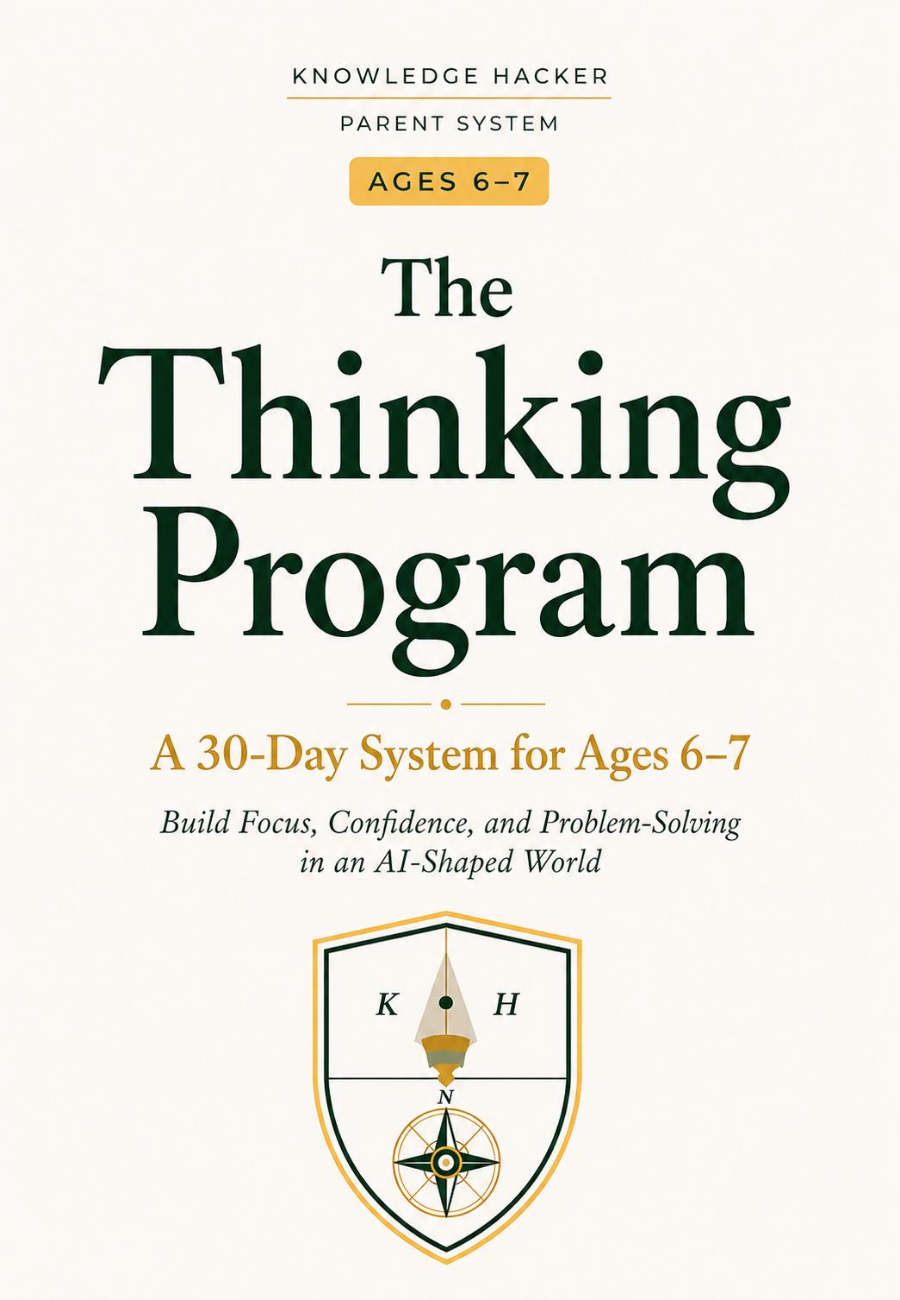
Ages 6–7 · 30-Day Programme
Build focus, memory, flexible thinking, and problem-solving in an AI-shaped world.
AI can process information fast. But only humans can think with creativity, empathy, and wisdom.
That's why thinking skills matter more than ever — and age 6–7 is the perfect window to build them.
This is a structured 30-day home programme that gives parents the tools to develop the cognitive skills schools don't explicitly teach — focus, working memory, flexible thinking, and problem-solving — through short daily sessions that feel like play.
15–20 minutes a day. 4–5 days a week.
Small daily moments. Consistent practice. Big future.
$35.00
Digital download — instant access after purchase.
AI can process information faster and better than the average person. The advantage belongs to children who can think with creativity, flexibility, and wisdom — not just those who know facts.
Most classrooms reward following instructions — sitting still, recalling answers, staying quiet. That's not the same as teaching children to think, adapt, and solve problems independently.
Screens and constant stimulation are rewiring young brains. Many 6–7 year olds already struggle to stay with anything difficult — and the habit gap widens quickly if nothing is done.
The best predictor of future success is not IQ — it's thinking skills.
You are your child's first and most important teacher. And age 6–7 is a critical window — their brain is still developing rapidly, and the right daily practice now shapes the thinker they become.
Each week targets a distinct brain skill, building progressively so each new skill is supported by what came before. No week is wasted — every day has a purpose.
Week 1 · Days 1–7
Build the ability to focus attention, listen carefully, and control body and mind.
Activities: Freeze Pattern, Tray Memory, Sound Copy Game, Colour Switch Race, Copy My Path, Hidden Sound Detective, Fast Find Challenge.
Week 2 · Days 8–14
Strengthen visual memory, working memory, recall, and sequencing skills.
Activities: Shopping Memory Walk, Build The Same Tower, Memory Story Builder, Finish the Pattern, Opposite Action Game, Picture Recall, Floor Maze.
Week 3 · Days 15–21
Develop cognitive flexibility, creative thinking, and the ability to adapt strategy when things change.
Activities: Which One Doesn't Belong?, Build Under Limits, Rule Change Toss, Shape Rotation Copy, Fast Category Switch, Missing Step Challenge, Copy The Map.
Week 4 · Days 22–30
Build planning, logical thinking, persistence, and real-world problem-solving confidence.
Activities: Obstacle Plan, Error Detective, Build From Memory, Rescue Mission Challenge, Bridge Challenge, Mystery Bag, Rule Change Challenge, Invent A Rule Game, Cognitive Challenge Course.
Every daily activity is fully structured so you know exactly what to do and say. Each one includes:
What to do
Step-by-step instructions you can follow immediately — most activities need no preparation at all.
Make it harder
Multiple progressive challenges so you keep your child in the growth zone as they improve week by week.
What to say
Exact language to guide your child's thinking — without giving away answers or creating pressure.
What you need
Most activities require only household items — or nothing at all. No special equipment required.
Brain skill focus
Every session is linked to its weekly brain skill, so your child builds a sense of what their brain is training and why.
Reflection prompt
A 30-second question at the end of each session to help your child notice what worked and what challenged them.
These are the ten thinking skills identified across the programme — the cognitive and character foundations that determine how well a child learns, adapts, and handles challenges in school and beyond.
The aim is not pressure or academic performance.
The aim is slightly harder than easy — the growth zone — where thinking actually develops.
The programme includes a built-in Progress Tracker and sticker reward system so you — and your child — can see development happening in real time.
Before you start, you rate your child on six key skills. At the end of each week you rate them again and celebrate the growth.
Children earn a sticker at the end of each completed challenge. Progress is measured against their own starting point — not other children. Every child grows at their own pace.
You're not just running activities — you're coaching a thinker. The words you use, how you react to mistakes, and the questions you ask all shape how your child approaches difficulty.
The programme includes a dedicated parent coaching guide that shows you exactly how to get more out of every session.
"What do you think will happen if…?"
Open questions that make your child think deeper — not just answer.
"I love how you kept trying different ways."
Praise focused on effort and process — not on talent or being "smart".
"What's your plan?" / "What's another option?"
Prompts that encourage strategies, not just guesses.
"This is tricky — and that means your brain is working."
Reframes struggle as growth, so your child pushes through instead of giving up.
Keep your tone: curious. Calm. Patient.
The goal isn't perfect answers — it's thinking in motion. Give your child time to think. That's where the learning actually happens.
This programme is designed for parents of children aged 6–7 who want a structured, daily system for building cognitive skills — not a loose collection of ideas, but a real 30-day plan with a clear weekly progression.
It is especially useful if you want your child to:
You don't need to be a teacher.
You just need this programme, 15–20 minutes a day, and the belief that your child can grow.
Ages 6–7 · 30-Day Programme
Small daily moments. Consistent practice. Big future.
$35.00
Digital download — instant access after purchase.